The goal of the Head of Evangelism JD is clarity and alignment. Let’s look at the responsibilities of the JD and map proposed initiatives to them.
Before we get to what the Evangelist will be focusing on initially, it’s good to understand what they are responsible for and how to track their success.
Responsibilities
below are the listed responsibilities of this role. Under each of the sections below, we’ll tag what responsibilities each effort contributes to and how.
- Connect teams internally to ensure they are aligned on the Logos mission, that they understand their role in it and with whom they need to collaborate.
- Evangelise the IFT/Logos word - at first internally to ensure internal alignment and then externally to build momentum.
- Educate internal & external audiences by creating simple narratives that can be easily understood and executed on. Information distributed via the following channels (and more): All-hands, Townhalls, Blog posts, workshops, Discord, Circles, events.
- Communicate the Logos vision and ensure it is understandable, believable, and shareable across the entire ecosystem.
- Drive the narrative of why the Logos unification matters.
- Inspire the organisation by helping to understand not just what to do, but why it matters.
- Coaches others to be able to speak about Logos in a compelling way.
Here are the proposed success metrics to help gauge how well things are going:
- Successful reunification of the Logos teams internally (removal of objections/friction).
- 100% comprehension of the Logos narrative amongst CCs.
- “Mission alignment” scores via engagement survey.
- Strong attendance (and participant ratings) for all-hands & townhalls.
- Content reach internally and externally.
- TBD amount of authored posts/content per quarter.
- Average engagement rate for content (#TBD)
Details of Proposed Initiatives
The following is a list of initial initiatives that bootstrap a unified understanding of Logos across the IFT Core Contributors as well as set the groundwork to expand into the larger Logos Community:
- Org wide agreement on specifications: what and how
- maintenance of Logos Assembly (this site)
- Logos Circles coaching
- Logos.co Website monitoring
- Strategy Roll-out and uptake
- Logos Broadcast Network creation and contribution
- Logos Stack Technical Diagram contribution and distribution
- All Hands Planning contribution
It is important to note that this is not exhaustive, but only a list of what the explicit focus at first will be. Over time, as feedback comes in and clarity is aligned, the strategy can adapt to whatever the organization feels is more important. Let’s look at each one to understand how it contributes to clarity and alignment across the org and broader.
Org wide agreement on specifications: what and how (Critical Focus)
Contributes to Responsibilities 1, 4, 5
Specifications are at the core of efficient development communication and collaboration, particularly when dealing with FOSS development. They DRIVE understanding.
Logos Assembly site maintenance and sharing
Contributes to Responsibilities 1, 3, 4, 7
Assumption: If we can get the entire org to contribute to and leverage this site in the manner of an open source project, then we can rapidly achieve alignment on what’s going on.
This website is an attempt to track and coordinate the creation of artifacts throughout Logos. Once something gets completed, the website then serves as a resource for where it exists and its effect on its intended audience.
When appropriate, the website will link to other places where certain coordination should happen instead. For example, the roadmap website (https://roadmap.logos.co, also quartz repos) will maintain Logos:
- weekly reports
- Roadmap
- FURPS
This site (assembly) can serve as a meta repo for those in order to help others understand “where stuff goes,” and who to go to if you have questions about it (resource map aspect of here, along with “meta docs”)
The Evangelist will maintain this resource and continuously leverage it to answer questions throughout the org. They will work with all Logos CCs to understand what’s being done and who’s doing it. They will teach others how to meaningfully contribute to it to help maintain understanding of Logos coordination.
This site:
- facilitates coordination
(1)by tracking cross team collaboration on artifacts being generated for the various audiences Logos cares about. - serves as a reference for those trying to explain what we’re doing by giving them artifacts we’ve created and distributed
(3). It gives examples on what narratives and processes we’ve used in the past to inform various audiences. - ensures the artifacts we generate are shareable
(4)by making them discoverable and make explicit the audience they’re intended for. - as it grows over time, displays the magnitude of effort being done by various parties to share the work we’re doing, and allows them to permissionlessly hone their arguments by referencing the information within it
(7).
You can look at the homepage or site plan to get a sense of what this is supposed to be, how it is supposed to work, and what we have planned for it (heavy WIP).
resources
- Claude convos:
Logos Circles
Contributes to Responsibilities 2, 3, 4, 5, 6, 7
It is imperative that the organization at large understand the problems of the communities that we’re fostering. Additionally, the requirements of those communities need to be formalized and understood such that we can be sure the Logos Stack satisfies them. There is a two way street that needs to be build so back and forth communication is efficient.
The initial initiative here will be to work with the Logos Circles groups and their leaders to help unify the process of understanding the winnable issues and their associated requirements such that our engineering efforts can identify whether or not our technical solutions are aimed in the right direction.
Working with Circles leaders:
- fosters the two way street of understanding between those who we’re working to help and evangelize and align our internal engineering efforts to the why
(2,3,4,5,6,7). - bubbles up the stories we need to get internal CCs enrolled in the Logos movement
(4, 5, 6) - coaches the Circles leaders to efficiently share what Logos is, what it offers today, and what it strives to offer tomorrow
(4,7), and how their contribution matters to the whole project.
Logos.co Website monitoring
Contributes to Responsibilities 1, 2, 3, 4, 5, 6
The website is the on-ramping of our culture. It proudly markets the lifestyle we aim to enable in others through the Logos movement. Additionally, it serves as external top of funnel for anyone interested in learning more and getting stuck in.
The Evangelist role will constantly monitor the interaction with the website and the effectiveness of the funnel to get people where they need to be. They will give feedback on narratives and stories and how we can hone them to push people to the right place.
Monitoring the Logos.co Website:
- ensures the top of funnel activity is engaging. If they are, we’re actively sharing believable and understandable narratives, then pushing people to where they’re most effective eat contributing
(2,3,4). - looks to ensure the narratives are placing people where they need to be, thus giving constant valuable feedback to the individual teams as to what their part is relative to the whole
(1).
Logos Launch Strategy
Contributes to Responsibilities 1, 2, 3, 4, 6, 7
This is the core focus up front: to ensure that the Launch Strategy document is clearly understood across internal CCs. It’s the core of what everyone is working off of and makes decisions in reference to.
The following sections outline the main areas of attention in ensuring that happens.
Establish and maintain feedback loop
In order to ensure alignment, it’s imperative that we maintain a tight feedback loop from those consuming the strategy and acting upon it. This means:
- CC consumes current strategy and execution documentation
- CC gives feedback where misalignment or misunderstanding occurs
- Leadership consumes feedback and responds, either adding context or filing identified gap in strategy
- Documentation is updated by responsible party
This gives the organization a chance to express their opinions and thoughts, which brings them into the process and work. It gives the organization the opportunity to continuously find gaps and fill them, or find better ways to explain what is there such that it gets received more fully (1, 4)
Organize Launch Strategy and Derivative Documentation
I have received feedback that the Logos Launch Strategy document is “a lot to take in,” which detracts from it being consumed and internalized completely. Furthermore, there is a lot of derivative documentation that needs to be generated from what exists today.
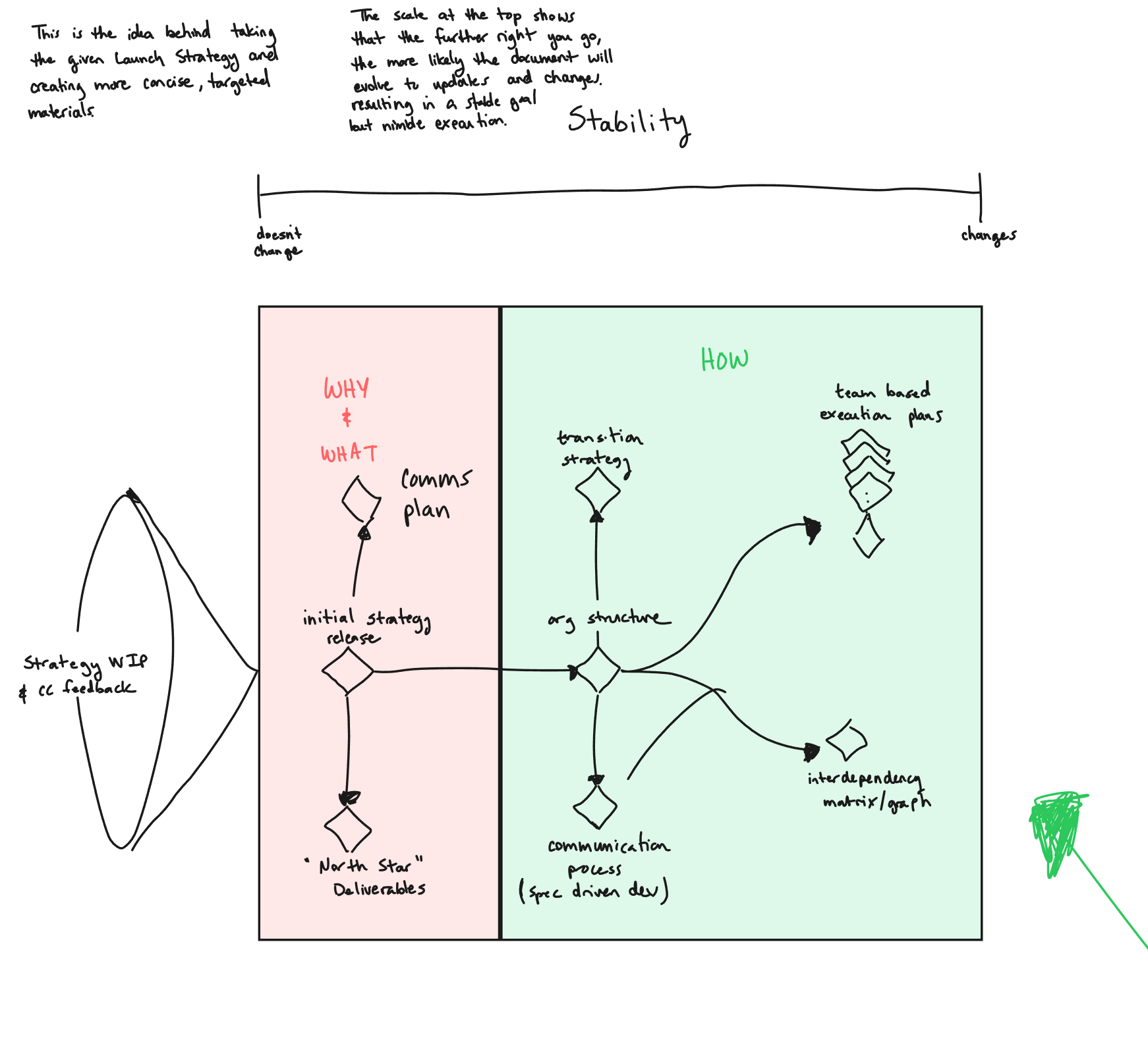
In order to ensure clarity and ease of consumption, it needs to be broken up and served in a manner that explains and re-explains all the moving parts at different levels of abstraction. There are many different types of people that need to understand the whole, but we can’t expect everyone to understand everything, so we need to ensure they get the whole point at the appropriate level of abstraction, and understand their part in it in the most detailed way, simultaneously (1, 3, 4, 5, 7).
Doing this also allows the documentation to be updated in parallel, by the people who intimately know their part, in real time.
The below diagram is a proposal for how I see the hierarchy of information, measured against the “stability” of the content the document includes. This way, it’s clear that the global strategy is solid and stable, but how we go about executing it is nimble and adaptive to our work and the external environment.
It is important to note that my role in this is to foster the process, not own the updates. Domain owners do the updates, or at least point to things that need updating, and the previously mentioned feedback loop helps the process of getting the documents actually updated.
Establish Reporting on Progress and Misalignment
As per the Logos Launch Strategy, each track will have a dashboard and metrics associated with their goals. Additionally, each team will have their own execution roadmap that points to deliverables.
Not only do these things need regular progress reports, but the alignment and adherence to Logos, both tech and culture, needs a progress report. Success of Logos is intimately tied to our unification and alignment towards the shared goals.
To that end, a process of gauging alignment will be developed and regularly held to inform leadership, the org, and the broader community how we’re doing, what gaps we’ve identified, and how we plan to fill them. (1, 3, 4).
This includes but isn’t limited to:
- regular alignment surveys to teams
- reports on the dashboards/metrics
- circles outcomes and winning stories
- analysis of cross team communication efficiency
Logos Broadcast Network
As it currently stands, we create and broadcast a myriad of content. We form a number of groups and have follow-up conversations in various places. The LBN is the coordinated effort of unifying all of these efforts, establishing expectations around scheduling, applying available resources, and ensuring consistency throughout.
Some examples of this are:
- IFT Townhall
- IFT Research Calls
- upcoming: Logos Launch Updates
- Dev Club
- Who is Logos podcast
- Communication Club
- AI/ML Club
The Evangelist will work with those coordinating and creating content on this network, ensuring that:
- what’s being broadcasted is aligned with Logos/IFT
(2,5). - is easily understandable and shareable
(3,4) - has call to actions, and enables others to do the same thing
(7).
resources
Logos Technical Stack Diagram
Contributes to Responsibilities 1, 2, 3, 4, 5, 6, 7
Status: Abstract diagram complete
see the details in Logos Tech Stack Diagram
The creation of a technical diagram of the Logos Stack, as we ideally see it, would serve a number of initiatives simultaneously, all of which improving clarity across the ecosystem.
Marketing Clarity
Marketing needs to understand how things fit together but can’t be expected to understand the technical details. A view of the highest abstractions and their dependencies allows them to see the big picture and how it fits together without them digging deep (3, 4).
When asking questions, having a diagram to reference helps them articulate their lack of understanding. As an example, there were recent questions around where the package manager fits in to the stack and how it relates to the rest of things. Pointing to the diagram allows for them to ask the right kind of question and for those who answer to explain with each other holding the same picture in their heads.
Justification of Organizational Structure
The Logos Launch Strategy required significant organizational changes. The strategy that is being followed is that of Conway’s Law, whereby organizational structure follows communication pipelines of the technology being built.
Having a technical diagram serves as the reference justification for organizational structure. It gives intuition for teams on why they’re broken up they way they are as well as who they should mostly likely be working with (technical dependencies) (1, 3, 4, 5)
Furthermore, when changes inevitably come that lead to technical changes in the Logos stack, updates to the diagram should serve to provide justification for team changes in the event those technical changes are large enough.
resources
Article: Life of a Txn Through Logos
described in Lifecycle of a Logos Txn
The Evangelist will coordinate with comms and technical leadership on writing this. It’s completion will enable:
- strong understanding of our complete tech stack and its differentiators
(3, 4, 6) - explicit examples of how the tech stack fits together and the interfaces between them
(1, 3, 7) - us to more easily point out where others get it wrong, and where points of manipulation exist that we’re covering to further safeguard users
(3,4,5,6,7)
resources
Bonus Efforts: Contextual AI Everywhere
Considering previous reasoning around our prioritization and focus of creating artifacts, it then reasons to ingest all of these materials into a global RAG to be used for various AI purposes.
LLMs are beautiful at providing an easy experience and helping people understand. RAGs are the current methodology for ensuring their answers are up to date on specific information. We already started this endeavor internally with the business intelligence team and the CaaS roll-out.
Expand CaaS
TODO
resources
- https://ask.free.technology
- https://github.com/status-im/data-docs/blob/master/docs/artificial_intelligence/overview.md
Introduce a Logos MCP Server
Claire from the BI team is creating a PoC MPC server leveraging Context7 to see how useful it would be to provide always-up-to-date Logos context to LLMs.